A NEW colony of black bees from South Yorkshire arrived in the post today - you should've seen the postie's face. They were making one hell of a racket but I'm hoping their hum is worse than their sting when I place them in their new hive this evening. He-who-should-be-obeyed-but-rarely-is has gone to fire up the smoker which I rarely use these days as the rest of my bees are very sweet natured. Watch this space.
Tuesday, 24 June 2014
SILO SNIPPET
A NEW colony of black bees from South Yorkshire arrived in the post today - you should've seen the postie's face. They were making one hell of a racket but I'm hoping their hum is worse than their sting when I place them in their new hive this evening. He-who-should-be-obeyed-but-rarely-is has gone to fire up the smoker which I rarely use these days as the rest of my bees are very sweet natured. Watch this space.

Tuesday, 10 June 2014
DRIVEN POTTY BY WASPS
I'VE INVESTED in a Top Bar hive which operates horizontally rather than vertically. I'm told honeybees much prefer this design and Prince Charles, self-styled protector of the environment and all things green, flogs them from his Highgrove Estate as well (for a King's Ransom!)
 |
WASPS' NEST in the making
is almost a work of art
|
Imagine my horror during the next inspection to find a bunch of wasps had moved in nextdoor ... if you remember I lost a weak colony of bees last year to the thieving raiders who launched unrelenting round-the-clock attacks. But this latest show of waspish hubris has taken their audacious nature to another level.
I removed one perfectly formed nest from inside the roof of the Top Bar, see below and scraped off another which you can see in the image to the right.
 |
CHEEK: This nest was found
underneath the roof
|
Admittedly there is something rather beautiful about their formation but a wasp is a wasp and should be swatted and squashed at every available opportunity.
The wasps that hang around my apairy are the winged equivalent to the fox which stalks the hen and turkey houses, but while he moves silently, unseen around the farm these wasps like to be seen and heard.
 |
PAPER WASP: Nest building using a mix of
saliva & paper
|
I believe the chief tormentor of my apiary is the European Paper Wasp seen below skillfully crafting a nest out of paper and saliva for its young; a work of art it may be but as far as I'm concerned it's something Damien Hirst can stick in formaldehyde anytime.
So I decided to do some reading up on how to combat the wasp and so reached out for ... Sun Tzu's The Art of War.
OK, a few raised eyebrows out there I'm sure but his book
is applicable to all aspects of life and there was some advice pertaining to my problems on the farm.
One of Sun Tzu's pearl's of wisdom read: “If you know the enemy and know yourself, you need not fear the result of a hundred battles. If you know yourself but not the enemy, for every victory gained you will also suffer a defeat. If you know neither the enemy nor yourself, you will succumb in every battle.”
And so now I am going to read up on the behaviour of the fox and the wasp. I really need to get into the mindset of my enemies as I am determined not to lose anymore poultry or bees to Nature's bad boys.
 |
DEMENTOR: The nightmare of us poor muggles from
the bee-keepingworld. Pic: B. Schurian, MfN
|
I've started already and to my horror I've discovered there are around 200 different species of wasps out there designed to make our lives a misery one way or another and last week a new one was found; and just to reflect popular culture the little pest has been given the rather grand name of Ampulex Dementor after the soul-sucking creatures from the world of Harry Potter.
 |
| LIFTING THE LID: Inside the Top Bar |
And as you can see from the shot taken above he even looks like one of the creepy, tortured souls that wreak havoc in the Harry Potter movies.
Mercifully I won't need to rely on a Petronus Charm to see it off since it's resident in Thailand and not Jedburgh, phew.
Monday, 9 June 2014
SILO SNIPPET
Our sick peacock is now blooming and stepping out with a spring underfoot. Panic over. Sadly our female Indian peacock is still missing and I'm now beginning to suspect a victim of the fox rather than sitting on a batch of eggs.
Wednesday, 21 May 2014
A SWARM IN MAY IS ...
..worth a load of hay
THERE is a proverb in 17th century bee-keeping circles that a swarm in May is worth a load of hay which means that it is worth far more than a swarm of honeybees later in the year when there's less time to collect pollen from blossoming flowers.
So imagine my delight when I spotted not one but two swarms while out walking in the woods; although I suspect at least one may originate from my apiary.
Still, the excitement of actually trapping and capturing my first ever swarm could barely be contained and so I made a flurry of phone calls to all of my mates in the beekeeping world ... not one answered their phone. I was well and truly on my own.
In panic mode I checked the many reference books I have and decided there was nothing for it but to go out and do it myself.
 Choosing to leave the smoker behind since I was banking on the bees being in an exceptionally happy mood ... and they were. Before bees decide to clear off they empty the hive of all honey supplies by drinking the stuff until they're so full. By the time they're airborne they're so bloated that it's virtually impossible to bend their bodies and use their stings; that they can reach their swarm meeting point is probably a minor miracle in itself.
The first ball-shaped swarm was hanging under the branches of an old Lebanon pine tree and I was able to literally give it a couple of tugs before it dropped in its entirety into the box.
I was so excited I forgot to take a picture of that one but the second swarm about the shape and size of a rugby ball was even easier to get. I simply snipped the branch they were hanging from and they dropped into the waiting box. As you can see from my cheesey grin in the selfie above I was absolutely delighted.
Both boxes are now sitting in the shade and will be put in a more permanent home once I've spoken to my mentor Alex.
I quite like the idea of starting up the Warre hive again or using my brand new top bar hive which I bought from a beekeeper in South Yorkshire the other day.
Top Bar and Warre hives produce that rough cut honey on the comb that so many people enjoy.
Which ever hive I opt for you can expect to read about it here in your favourite countryside column soon!
 |
| HAPPY & relieved |
So imagine my delight when I spotted not one but two swarms while out walking in the woods; although I suspect at least one may originate from my apiary.
Still, the excitement of actually trapping and capturing my first ever swarm could barely be contained and so I made a flurry of phone calls to all of my mates in the beekeeping world ... not one answered their phone. I was well and truly on my own.
In panic mode I checked the many reference books I have and decided there was nothing for it but to go out and do it myself.
 |
SWARM BALL of bees clinging to a
Rhododendron branch
|
Since hubby was not around this was going to be a difficult task and so I went for simplicity and armed myself with nothing more than a pair of sharp scissors, a brush and two plastic boxes containing frames of wax.
Choosing to leave the smoker behind since I was banking on the bees being in an exceptionally happy mood ... and they were. Before bees decide to clear off they empty the hive of all honey supplies by drinking the stuff until they're so full. By the time they're airborne they're so bloated that it's virtually impossible to bend their bodies and use their stings; that they can reach their swarm meeting point is probably a minor miracle in itself.The first ball-shaped swarm was hanging under the branches of an old Lebanon pine tree and I was able to literally give it a couple of tugs before it dropped in its entirety into the box.
I was so excited I forgot to take a picture of that one but the second swarm about the shape and size of a rugby ball was even easier to get. I simply snipped the branch they were hanging from and they dropped into the waiting box. As you can see from my cheesey grin in the selfie above I was absolutely delighted.
Both boxes are now sitting in the shade and will be put in a more permanent home once I've spoken to my mentor Alex.
I quite like the idea of starting up the Warre hive again or using my brand new top bar hive which I bought from a beekeeper in South Yorkshire the other day.
Top Bar and Warre hives produce that rough cut honey on the comb that so many people enjoy.
Which ever hive I opt for you can expect to read about it here in your favourite countryside column soon!
AS PROUD AS A PEACOCK
..& as sick as a Peahen
 |
YOLK CLUES: Sticky yellow
feathers underneath
|
 |
| PHILOMENA: Pale & disinterested |
Meanwhile, one of my white peahens, Philomena, has been out of sorts the last couple of days and I think she has had egg trouble. At least that's the conclusion drawn by a really nice bloke called Martin who breeds and sells peafowl from his farm in Ormskirk, Lancashire. Here is his website: http://www.browfarm.co.uk/peafowl/ I bought my Indian Blues from him last year and called him a few hours ago to ask his advice. Although I didn't buy my three whites from him he was happy to listen and counsel on what might be the problems. We think Philomenia has just started laying but two days ago her wings started drooping and she moved very slowly with each step being made in an extra cautious way. You can see by her expression (above) she doesn't look happy.
 |
DROOPY wings are a tell-tale sign all is
not well with white peahen
|
 |
HAPPY FAMILIES: Albert looks on as 'droopy' Philomena
is comforted by her two companions (centre and far right)
|
On closer inspection I noticed her undercarriage was sticky and yellowy as though she'd sat on some egg yolk and that might not be too far from the truth. Martin reckons she's just started laying and may be one of the eggs didn't have a shell ... I know that's happened to my hens before. Or, it could be that an egg has cracked inside her. The good news is that she's covered in what could be yolk underneath which means whatever was inside her is now coming out. I would have put her in isolation until she recovers but the other peafowl seem to be comforting her in her hour of need.
There's very little I can do other than give her a high protein diet and she has started to nibble at her food which is another good sign.
There's very little I can do other than give her a high protein diet and she has started to nibble at her food which is another good sign.
Obviously I will keep you up to date with any changes and if you can throw in some advice please do. Feedback is always welcome.
Monday, 19 May 2014
GETTING A BUZZ FROM BEES
..And not a sting!
BEEKEEPING Is relatively easy but when things go wrong they can go really wrong and I was caught up in a rather nasty experience just the other day ... happily for me I was more on the sidelines and not in the thick of it for once.
But this is a salutory tale and shows when SH one T happens it can happen to the most experienced of beekeepers.
Wanting to build up my stock I was scanning various sites to find if any beekeepers had a colony or two for sale and there, right in my native County Durham, was a chap who had two.
We agreed a very reasonable price and I arranged to pick up the bees and set about preparing the colonies for departure; they were black bees which have a reputation for being a tad more volatile than other strains like my cuddly Buckfasts.
 |
STEADFAST & FRIENDLY: Buckfast bees like the ones from
my apiary above, are known for their good temperament
|
As I headed to collect the bees I made a call and his frantic wife garbled the word "trouble" adding that "they're going crazy, I can't let the children out and they're bouncing off the windows."
Initially I thought she was having problems with the kids and wondered what a set of rowdy young'uns had to do with me. Apart from hoping her double glazing would not crack under the strain of these lively offspring I was rather bemused by our conversation.
When the penny finally dropped it transpired the kids weren't going crazy but the bees were and in the interests of everyone's safety the garden was under lockdown while the president of the local beekeeping association went along to check out the situation.
My new best friend the beekeeper had been trying to gather one colony which had decided to swarm when the second colony of black bees suddenly erupted and went in to psycho mode just like on the film Swarm about a killer strain of bees.
Try as he might he was unable to pacify them and following advice from fellow beekeepers he had to do the unthinkable and destroy the entire colony by fire. As he told me the story I felt so sorry for him although he seemed more concerned that I would be upset at losing the promise of two colonies.
Quite what triggered the incident is still a mystery but bees are incredibly sensitive to smells and they communicate with each other using alarm pheromones.As long as they can smell/communicate with their queen most bees are happy but hives can turn testy when they become queenless.
However these bees were out and out psycho. His fellow beekeepers thought the killer behaviour could've been triggered by a certain species of orchid or flower which can trigger an alarm pheromone while someone else thought it could be some type of nectar which has a seven day kicking in process before the bees turn nasty.
I've heard compost heaps which are constantly in some sort of fermenting process could do it with byproducts of smelly compounds such as n-Butanol and Isoamyl acetate. If they produce a pong which can mimic a bee's alarm pheromones that could cause them to attack.
Whatever happened I am heartily sorry for the beekeeper who lost two colonies but I am eternally grateful I did not get the bees just before they turned psycho.
However, it got me thinking. I wonder how I could trigger such a reaction in my bees everytime the fox appears - a swarm attack like that would see him off once and for all.
In the meantime if you know anyone with a spare colony of bees to sell do let me know - but I would prefer nice, happy clappy bees.
Friday, 16 May 2014
TURKEYS OUTFOXED
Home, home on the range ... where the turkeys and Mr Fox play
I BOUGHT some Bronze Norfolk turkeys last autumn, cute little things barely three weeks old.
So far I've resisted naming them and so my plans to produce some free range birds for the table were going well.
Corn fed every morning I've let out the birds so they can roam freely until about an hour before dusk. The weather has been brilliant these last few days and they've really enjoyed themselves having dust baths and stalking around the undergrowth.
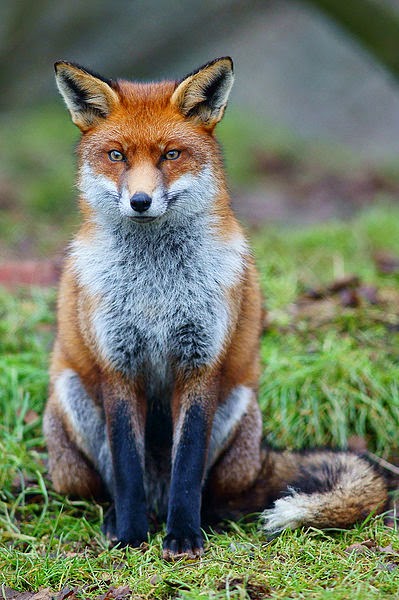
However, every day for the last three days a bird has disappeared and the culprit was spotted hanging around today, bold as brass and in broad daylight.
A young fox, who probably has his own cubs to feed, is now looking like the prime suspect responsible for the daring day time raids on my small-holding.
Foxes normally go in for mass killings but this sly dog has embarked on a hit and run exercise leaving no evidence or trail or even feathers.
I can either keep the birds locked up in a dark stable or let them roam free until Mr Fox takes the very last one. Neither option is desirable and so we've decided to slaughter the birds since they've all reached a good weight anyway.
As hubby said: "I'm damned if we've reared them to feed that bloody fox." He-who-should-be-obeyed-but-rarely-is is now busy sharpening his knife while I give my birds their last feed.
 |
STUFFED: No more turkeys for the fox
like the one above.
|
I BOUGHT some Bronze Norfolk turkeys last autumn, cute little things barely three weeks old.
So far I've resisted naming them and so my plans to produce some free range birds for the table were going well.
Corn fed every morning I've let out the birds so they can roam freely until about an hour before dusk. The weather has been brilliant these last few days and they've really enjoyed themselves having dust baths and stalking around the undergrowth.
However, every day for the last three days a bird has disappeared and the culprit was spotted hanging around today, bold as brass and in broad daylight.
A young fox, who probably has his own cubs to feed, is now looking like the prime suspect responsible for the daring day time raids on my small-holding.
Foxes normally go in for mass killings but this sly dog has embarked on a hit and run exercise leaving no evidence or trail or even feathers.
I can either keep the birds locked up in a dark stable or let them roam free until Mr Fox takes the very last one. Neither option is desirable and so we've decided to slaughter the birds since they've all reached a good weight anyway.
As hubby said: "I'm damned if we've reared them to feed that bloody fox." He-who-should-be-obeyed-but-rarely-is is now busy sharpening his knife while I give my birds their last feed.
Subscribe to:
Posts (Atom)