Showing posts with label honeybees. Show all posts

Wednesday, 26 June 2013

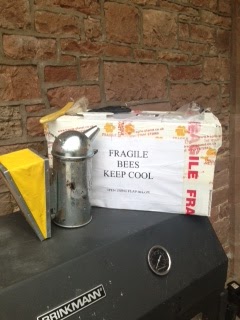
POSTMAN DELIVERS FIRST CLASS COLONY

WHAT'S INSIDE THE BOX? The clue
is in picture as my postman pointed out
..And another red letter day in the apiary

 AT LAST! My much awaited colony of Buckfast bees arrived today via the postman who did not share my enthusiasm as he asked me to sign for the parcel.
 'You'll never guess what's inside,' I said but he replied dryly: 'Bees, and they don't sound happy,' as he passed the parcel. OK, so it was marked 'BEES' in large letters but he could've indulged me. The occupants were indeed buzzing very, very loudly and even the box was vibrating.
 I knew I should wait, may be keep them stored overnight until my other half arrived to help me unload our honeybees into their hive but patience is not a virtue of mine. It was also proving to be an incredibly hot day and I thought the last thing the newbys would want was to spend another day in a box.
 So I swung into action and got the smoker going, donned my white beekeeper's outfit and prepared the hive for the noisy Buckfasts. 
 For those interested, this type of bee was developed by a German-born monk called Brother Adam (1898-1996) who kept bees at Buckfast Abbey in Devon. After huge numbers of the British black bee were wiped out in the second decade of the last century due to an epidemic of acarine disease he set about trying to breed a special strain of resistant bees. At Buckfast the only colonies not affected by the disease were those headed by Ligurian queens and hybrids of these queens with British black bees. 
 Brother Adam's lifelong quest to breed a strain of honey bee that would contain as many desirable qualities as possible for beekeepers is carried on today by his followers and beekeepers across Europe. In order to do this however, it was necessary to be able to control the mating of the selected queens with selected drones and thus a mating station at a remote spot on Dartmoor was established in 1925, this was in continual use until the mid 1990’s. There is a Buckfast club and more details can be had here: http://www.buckfastbeekeepersgroup.co.uk/
 As I bent down to open the box it suddenly occurred to me these little fellas would not be in the same party mode as the chillaxed Ayshire swarm we handled about 10 days ago ... swarm bees are usually full of honey and their bodies so bloated they can't physically sting you even if they wanted. Also all that honey has a pacifying effect but this colony didn't sound happy at all.
 After saying a little prayer I opened the lid to reveal five frames which I then gently placed inside the hive. The Warré (pronounced war-ray) is supposed to be simple to manage and maintain and was designed by some French bloke called Emile Warré (1867-1951).  After experimenting with 350 different types of hives he came up with the Warré and called it the Peoples' Hive. It's supposed to be popular with bees as well since they are allowed to draw out their own comb. New hive boxes are added to the bottom and not the top of the hive which encourages the bees natural tendency to build down ensuring an environment that is healthier and better suited to their own needs. That's the theory, anyway.
 There were still quite a few bees in the box but I reckoned, as I put the top back on the Warré, they would go inside of their own accord because of the Queen. OH NO, THE QUEEN! That feeling of Déjà vu swept over me as I said to myself: 'The Queen, the Queen ... I forgot to look for the Queen!'
The last thing I wanted to do was go back into the hive and start searching around for the Queen. 
 As I returned back to base, cussing myself along the way, I found an envelope which must have slipped from the box as I ripped away the sticky tape and excess paper ... it contained the instructions of what to do with the new colony. Suffice to say what I did bore little resemblance to the list of dos and donts but at least the end result was the same ... the bees are in the hive and several checks until late this evening revealed they were doing what busy bees do, as you can see from my short video.
 

Tuesday, 25 June 2013

WHERE'S THE BLOODY QUEEN?

.. And do we have a Plan Bee?

FOR THE past couple of weeks hubby and I have been in and out of our beehive since collecting a swarm  from Ayr earlier this month. This wasn't how we planned things as in the apiary world less is usually more and once we'd settled the bees in their National hive we hadn't planned to disturb them for a while.
DOUBLE BEE CUP: Busy bees kept on building 
after running out of the wax foundation on the 
short frame
 However we're heading towards the end of June now and we've not seen the Queen Bee or evidence of her existence. And as even the most novice beekeeper knows, a hive can not operate without her and the colony is doomed to fail unless a remedy is found. So my mentor who lives near Edinburgh kept telling me to go back into the hive and find the Queen. Now despite our Laurel and Hardy antics - we even forgot the smoker to pacify the hive occupants on one occasion - hubby and I have not been stung once because those bees seem to have an unbelievably nice nature and are extremely tolerant of our fumblings in their abode. In the end we took some photographs to try and find clues of a queen's existence - eggs or larva would do it. I sent this picture on the right to my mentor who must have laughed off his socks - I'd made a basic schoolboy howler by inserting a shallow 'super' frame into the much deeper brood box. As you can see the bees have been so busy they carried on making honeycomb despite running out of the foundation material. Now apart from giving everyone a good belly laugh at my expense - and no doubt some weird ideas to the S&M world of fashion - this picture does reveal my bees are conducting themselves in a normal manner despite the best efforts of their abnormal keepers!
FRAMED: But can you spot the queen?
 However my mentor urged me to make preparations for a new queen just in case the old one had been squashed by us or had been left behind when the swarm was collected. Believe it or not there's a whole industry supporting beekeepers and there are people who breed Queen Bees. So I contacted a woman in Inverness who sells queens and I told her my problem. She could've just sold me one straight away - you can pay anything from £25-£50 for a queen bee - and let me muddle on in my haphazard manner but she realised how green I was and asked a few more questions about the condition of the bees, the comb and the hive. Her company Highland Bee Supplies is worth a plug because she was so helpful, so here it is: http://highlandbeesupplies.com/
 Anyway, she reckons cos my bees are so placid, content and busy there must be a queen in the hive. "You've probably got a virgin queen, one that hasn't yet mated. Give it another week and if there's no sign of egg laying activity call me back."
 In the meantime I receive a new colony of english bees tomorrow from Shropshire and someone has also suggested I nick one of the brood frames from that colony and stick it in my first hive. The reason being is that if the Virgin Queen is inside and hasn't yet mated this will encourage the worker bees to produce some queen cells just in case and if there isn't a queen then the workers will turn some of the eggs into queen cells anyway and create a ruler for their hive.
.
 .
Apparently a colony without a queen can go psycho and aggressive. Mercifully my Ayrshire colony is still in party mode so let's hope their good nature continues. In the meantime there's a mini video shot from the apiary and you can judge for yourself the temperament of my honeybees.