Wednesday, 17 July 2013

ANARCHY IN THE APIARY

..Or what happens when chaos is introduced into the bee world

JUST recently hubby and I went to Lincoln to pick up three beehives after their keeper was forced to sell following a life-threatening encounter with the occupants.
TROUBLE at large in little white hive
second from the right
 He was literally nearly stung to death after accidentally knocking over a couple of the hives and hasn't been near them since. So quite what to expect on making our first inspection of our new acquisition when we got back to the Borders was anyone's guess.  Thankfully my mentor, Alex Turnbull, a beekeeper of 35 years experience, came along with his kit and we set about inspecting all three hives. We went through the National hives with relative ease until we tried to lift off the lid of the smallest. We actually thought it would be a doddle since the outward signs showed lots of healthy activity and there was just a brood box to check. But come hell and high water, we simply could not remove the top despite trying to chisel away from inside the lip of the lid.
 As you can imagine the bees were starting to get a tad irritated and I reminded Alex that the last person to take a peek inside this hive had ended up in Accident and Emergency, but he seemed undeterred. 
 Hubby arrived on the scene just in time and he stepped up to the plate to deploy some Algerian brute force. We held our breath and winced as he huffed, puffed and eventually using a twisting, lifting movement prised off the top ... by this time he was engulfed in a mini tornado of bees but they didn't seem in a mood to sting happily for him. Bearing in mind a bee will die after using its sting, you really have to rile them to invoke an attack so while they seemed angry, they appeared to be all bluff, buzz and bravado. As he slowly began to lift the lid, which he said felt unusually heavy, Alex and I both shouted in tandem: "STOP!"
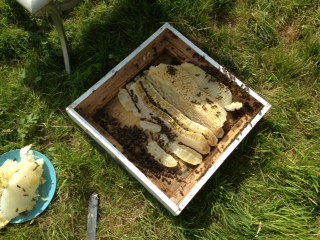
CHAOS as bees go freestyle without frames to guide them
 So there he was, frozen like a statue being buzzed by a considerable amount of bees, as Alex pondered what to do. He shook his head in dismay and muttered several different scenarios saying how bad this all was. Hubby, who has the patience of a water gnat, began to purse his lips, fidget and perspire. Eventually Alex sighed and declared: "This is chaos, complete chaos. Slowly put the lid back down." We all congregated in a huddle nearby and Alex painted the scenario. Basically there were a couple of frames missing from inside the brood box - that's the chamber where the Queen lays her eggs. Other frames were skew-whiff and if anyone wanted to know what happens when anarchy breaks out in the controlled environment of a bee hive this was it. After the accident the lid must have just been replaced in a hurry and the bees were left to get on with it - and get on with it they did. They tried to bring order by making a wax brood frame without the frame which is a bit like knitting but without the needles! Using the top of the roof right down to the bottom of the hive, these tiny engineers had set about creating a solid wax structure, securely anchored which was used for the brood. It was one big sticky mess! So when hubby lifted the lid he also ripped up six free range combs from their solid anchor on the floor of the hive.
There was no quick fix solution for this so we set about on a damage limitation exercise, under the supervision of our mentor. God only knows what we would have done had Alex not been there but as you can see from the picture above this was a really complicated problem beyond our comprehension. There was nothing in the text books to cover this and certainly no mention of rubber bands, makeshift frames and how to deal with free range combs.
 We didn't even bother looking for the Queen - actually, we didn't have to as the whole heaving mass was full of eggs and larvae; proof positive an extremely fertile, active Queen was in action.  
STRETCHING IT: Six elastic bands restore some order
 Rather than destroy the wayward combs of brood we got three empty frames and somehow rescued part of the Queen's nursery by cutting the egg and larvae-laden wax to fit inside the frames. The whole structure was held in place either side by elastic bands. If you look closely at the picture on the right you can see the tell-tale signs of our DIY using the red elastic bands. The large wavey comb also in the picture is where the bees have constructed freestyle expanding the wax cells to fit the void. After our emergency repairs, and only one bee sting (Alex's head), we closed the hive and will check back in two weeks time. May be then we will look for the Queen. The whole exercise took the best part of two hours but it was an exilarating, if not tense, experience for a couple of rookies like me and my other half. Alex's presence also reinforced the view that all 'learner hivers' need a mentor on hand and he said himself that a bee apprenticeship should take around three years if such a thing existed.
 But whatever we went through with this hive inspection, nothing could prepare any of us for what we found when we inspected the hive which contained our first ever a swarm collected only last month from Ayr. Even now Alex is perplexed and has no answer for our shocking discovery ... but more of that later.
(Part two to follow, soon)


SILO SNIPPET

HARD CASE TO CRACK: is this a one off or the start 
of something more serious?

SHELL-SHOCKED! That was how I felt when I collected the latest batch of eggs from my Scots Dumpys today and tried to pick up this egg pictured right. It had no shell!
 As you can see it's perfectly formed and the membrane covering it clearly contains the egg white and yolk but it feels squishy and rubbery.
 Let's hope it's just a one off. I'll put more oyster shell out for the birds to peck in case there's some sort of deficiency in their diet.
 As usual, I'm blundering around in the dark on this one - any advice?

Sunday, 14 July 2013

BEWITCHED, BOTHERED AND BEEWILDERED


In other words ... what the hell is going on?

 I THINK my swarm has swarmed! "Impossible!" declared my mentor down the telephone line. And according to the experts and all the bee books on my bedside table it's not supposed to happen but unless about 8,000 bees have gone off for an away day to Oban, I think it has.
Happy days: The swarm from 
Ayr snapped just last week
 The swarm, if you remember, was collected on a rainy day in Ayr last month and they seemed perfectly happy in the Borders until the arrival of some Buckfast bees which were housed about 10 yards away in a Warr
é hive. That day their mood changed and I was stung three times but they seemed to recover from the arrival of the strangers however three more colonies were introduced to the apiary yesterday. May be that has triggered their departure unless they've been wiped out by some pesticides while foraging. He-who-should-be-obeyed-but-rarely-is insisted we take a peek to try and find the Queen and if she was there then all would be fine. Well we couldn't find her, but it's not that unusual ... she eluded us for nearly a month which almost made me go and buy a new Queen by mail order to save the colony. However there are six queen cups on one frame and one of them contains a larva which means the colony is preparing for a new queen. My mentor, who is President of the Caddenfoot Beekpeers Association is coming around tomorrow to make an assessment and he also wants to check my new hives.
BUZZIN' WITH EXCITEMENT ... and that's 
just hubby as he hovers over the Warré
 They came from Lincoln after a beekeeper there had a life-threatening reaction to a series of bee stings inflicted when he tripped over a hive. His eye-watering account of what happened made me realise you can not take the honey bee for granted. For a past-time which is supposed to take an hour a week I think I've already packed in a decade's worth of work, not to mention the sleepless nights, stings, homestudy, exams and volumes of reading. But you know what? I am completely bewitched as well as bothered and bewildered, as the song goes, by the honeybee and its lifestyle and work ethic, especially those in my backyard.  While pondering the whereabouts of the Ayshire swarm bees - there's still around 5,000 left - we decided to add another set of frames on to the Warré hive. Unlike most hives with the Warré the new supers are placed from the bottom upwards as the belief is that bees prefer to work downwards. My mentor says it's piffle and, as a dedicated National hive advocate he hates the Warré. It's amazing but nothing gets the bee community more polarised than a conversation about hives. While the rest of the world favours a model called the Langstroth in the UK the National is the predominant choice of beekeepers followed closely in Scotland by the Smith and then there's the WBC and a host of others as well as top bar hives like the Warré.
DOUBLE TOP: A new super has been added
to the Warré
 Apparently The Langstroth bee hive, patented in October 1852, was developed so that the bees could construct honeycomb into frames, which can be moved with ease. It was the brainchild of an American, the Reverend Lorenzo Lorraine Langstroth (1810–1895), a native of Philadelphia, who discovered "bee space" and noted that when his bees had less than 1 cm (3/8 inch) of space available in which to move around, they would neither build comb into that space nor cement it closed with a sticky glue called propolis. He then set about creating a revolutionary, newly-designed frame
which would prevent the bees from attaching honeycomb to the inside of the hive box.  I'm told if Langstroth had been born in Birmingham, Brighton, Bognor or somewhere else in the UK, rather than in the 'New World' his hive might be in common usage over here today but the crusty old guard inside Britannia's upscale bee circles couldn't stomach the thought of embracing such an idea from a chap in the colonies!
HIVE FIVE: Our apiary is growing by
the day
 Thankfully the beefolk we've met on our journey have been kind, helpful and courteous and our new best friend and mentor Alex Turnbull is a gem. I will report back on his views about the missing bees from Ayr and reveal what we find inside the three new hives which have not been disturbed since they arrived from Lincoln 223 miles away.
 If you have a theory about the missing bees please share your view; all feedback welcome.


Saturday, 13 July 2013

POSH BIRDS SETTLE IN TO DES RES

..But local wild pigeons may lead them astray

REGULARS of Soho 2 Silo already know I am now the owner of some beautiful white fantail doves after a nostalgia attack during a bird auction in Cumbria recently.

THERE'S NO PLACE ... like home
 The sight of the fantails on the auction room floor suddenly propelled me back more than four decades to the chaotic journey on the Scholars 4 bus in my home town of Stanley, County Durham.
 One of the landmarks on the route from Stanley Grammar School to home used to be a corner house where stunning fantails would pose and perch from a beautifully painted dovecot.
 The ride home from school was always manic, loud and rough but everything would stop for those 10 seconds as we hurtled past the exotic looking dovecot in the gritty mining town.
 However when I bought the birds if I thought recreating a scene - minus unruly schoolkids - was going to be easy I was wrong.

DES RES: With temporary
scaffolding & netting 
 The fantails have been housed in a large bird cage while I spent the last few days trying to find a bargain dovecot. Eventually it arrived and hubby, bless him, set about painting it and then planting it deep into the ground secured by concrete.
 It occurred to me that the fantails had become quite settled in their cage and probably would freak out at their new upscale residence outdoors so I bought a massive big net and with various ladders and created a tent-style effect to hold in the birds as you can see in the pictures.

POSH BIRDS may be targetted by local pigeons
 I'm told if they remain there for the next few weeks then this will imprint as their base and if they do fly off their homing instict will kick in and bring them back. So, by the time Ramadan is over I should be able to remove the netting and just hope the birds remain.
 However, some alarm bells began ringing after I heard the sound of local wood pigeons cooing this evening. According to one local the wild birds may try and make the doves fly with them until they become part of their flock and disappear.
 Without sounding like a snob, the last thing I want is my lovely posh fantails mixing with local pigeons.
 I have a feeling, like just about everything else I've taken on in my Borders small-holding, this is not going to be as smooth running as previously expected.
 Advice please ... as long as it does not involve a shotgun and a recipe for wild pigeon pie!


Thursday, 11 July 2013

SILO SNIPPET


UNEXPECTED ARRIVALS: The swarm bees from Ayr
CRIKEY! After waiting impatiently for more than a year to get some training and then our hands on a colony of bees I've come to the conclusion these honey gathers are like the proverbial London red bus ... absolutely nothing for ages then suddenly three pull up at once.    Last month I ended up ordering a colony of bees by post but while waiting for them I was offered, out of the blue, a swarm in Ayr. And now I'm heading off to Lincoln to pick up three more colonies from a beekeeper who has lost his immunity to bee stings. Pour soul is distraught because he loves his hobby but it could literally kill him if he continues. I shall give a full report once we've settled the newbies in to our apiary in the Borders.

Tuesday, 9 July 2013

HIVE I GOT NEWS FOR YOU


..One award and two Queens


REGAL RED: Our magnificent Buckfast Queen Bee
 I AM buzzing with excitement today as me and my honey (a new, affectionate term for he-who-should-be-obeyed-but-rarely-is) have just become Basic Bee Masters after a gruelling outdoor test in the midday sun with an examiner from the Scottish Bee Keepers Association.
 Not only that, but while showing off our prowess as competent beekeepers (thank goodness he didn't see our antics last night) we finally discovered the two elusive queen bees who have caused so many sleepless nights of late.
 As regular followers know, we've had a frightful, nail-biting time with a swarm from Ayr. We spent the first two weeks wondering if the hive was queenless, then thought the queen could be a virgin who needed to be mated before embarking on her egg-laying process. Three weeks later and still no eggs we even thought a hungry bird may have made off with the Queen during her mating flight and then we had the nightmare scenario of no queen and a total breakdown of the bee society which was installed last month in our National Hive.
 Well as we went through our routine in front of the examiner my other half could barely contain himself with excitement when he spotted the queen at long
last.  There she was with a tell-tale yellow dot stuck on her back, no doubt, placed by the previous owner before she headed off with her swarm. Normally the colour gives away the year the queen's reign began but our examiner cautioned that some beekeepers simply use yellow because it's a bright colour and it might not necessarily mean she emerged from her queen cell last year (2012 queens should be marked yellow).
 Goodness only knows where she's been hiding but there she was in all her glory being waited on hand and foot by her loyal workers. Our examiner reckons she's an Italian bee because of her colony's light colouring and the almost manic, non-stop activity inside the hive complimented by her such good-natured subjects.
 After inspecting the frames we then went indoors for an oral exam where we were put through our paces individually. After the nerve-wracking experience we were told then and there that we had passed the rigorous SBKA test with more or less the same points - sadly not enough for a distinction but a good, credible pass rate nevertheless. After advising us to return to the National Hive for a few quick maintenance jobs which needed to be carried out he was gone. Feeling thoroughly empowered we returned to our apiary and bouyed by our success decided to sneak a peek inside our Warré hive and check on the small colony which arrived a couple of weeks back.
BREAD & HONEY: A simple but perfect pleasure to cap a brilliant day
 It was then that I spotted our magnificent Buckfast Queen Bee pictured above - she's the one with the elongated body and is sporting a red dot to signify her birth in 2013.
 Back home for a celebratory tea I made hubby his favourite Italian bread and he produced some wicked honey comb he'd snapped off from one of the frames in the National. If you remember I'd put in the wrong sized frames and since they were too small for the brood chamber the bees had carried on making their own honeycomb. I can tell you the honey was delicious and had a very distinctive taste probably drawn from the nectar of three giant lime trees nearby.
 Homemade bread, honey from our first hive and official acknowledgment  that we can now call ourselves Basic Bee Masters has made our day - that and the sighting of the two queens. All this on the eve of Ramadan which is considered by we Muslims to be the most sacred month in the Islamic calendar.
 So to all Soho2Silo readers I say: Ramadan Kareem and to those of other faiths and no faiths I hope this blessed month starts off as well as mine.

Monday, 8 July 2013

CLOSE ENCOUNTERS

.. And strange alliances as feathers fly

IT IS very easy to attach human characteristics to animal behaviour and the film industry loves to do it as is evidenced by the various tear-jerking productions on stranded whales, heroic dolphins, mischievous kangeroos, courageous horses and loyal dogs, cats and mice.
 But something happened the other day which I feel compelled to share and, if you do attach human characteristics to the actions you are about to see then it would appear that there are parallels to human behaviour which can be drawn in the animal kingdom.
 Horatio, a fine Scots Dumpy cockerel, arrived in the Borders from the Isle of Wight as the alpha male (actually the only male) in August last year keeping order among seven other hens. All was fine until I introduced Napoleon, an older black Dumpy, who immediately assumed control of the hen pen and then chaos arrived with a younger, third cockerel ... known as Jumping Jack.

 After a couple of minor scraps all settled down until a few weeks back when Jumping Jack tried to assert his authority and launch a coup. Like most aggressive takeovers it was messy, tempers flared and chaos ensued. The end result was Napoleon maintained his pole position and respect of the hen pool while poor old Horatio ended up being totally excluded socially. Of course this all made highly entertaining viewing for the turkeys, who've now lost interest in their own reflections from a mirror I installed in their stable. Their routine most mornings is to head straight for the hen pen and watch - possibly with mild disdain - the goings on of their smaller, more excitable cousins. Although I was told that turkeys and hens shouldn't be allowed to mix in the same area, since all my birds are relatively free to wander around it has become impossible to keep them apart; and now that the  sun has finally arrived in the Borders they're free to roam around and mingle at will.
 Some strange alliances have been formed as a result as you will see from the two short clips. The first one, above, shows a clash between Horatio and Jumping Jack - it is a rare moment of real aggression and I would've intervened but someone beat me to it ... as you will see in the second clip.
I'd also like to point out that, apart from a few bruised egos, no animals were hurt in the making of these videos.
 Should these flare ups become regular occurrences it is obvious I will have to review where the cockerels are kept but at the moment an uneasy truce is now in force thanks to the female turkey Little Boots who emerges as the real star in all of this.
 Feedback, advice, as always is greatly appreciated.